
Experimenting … and having fun.
Some experiments in photography are pretty simple, but still … one can encounter unexpected results, or simply have some fun. Here are a few with my Canon 6D full-frame DSLR.
Multiple exposure
This is a powerful feature, which can be quite amusing. It did, of course, exist in analog photography, but only with a digital SLR one can fully control and verify results while shooting.

This first example is really very basic. The plant on a shelf in my studio is very old – we got it from one of the neighbors down the street when we moved to our house, so it must be around 30 years old, and it blooms with a single flower just once a year, between May and July. All right – so let us give it three flowers with the multiple-exposure feature while averaging exposure parameters. The result is quite pleasing. Note, that it is the same single flower, but just by shifting the view horizontally (with locked focus) the neutral LED light falling on the petal causes a slight shift in color, thus giving the natural impression of three different flowers. Shot with Canon EF 100 mm macro 1:2.8L IS USM lens at 1/20 sec, F 2.8, ISO 100, using tripod. The F 2.8 aperture combined with a single point auto focus allowed to achieve very shallow depth of field, while keeping the petal in sharp focus.
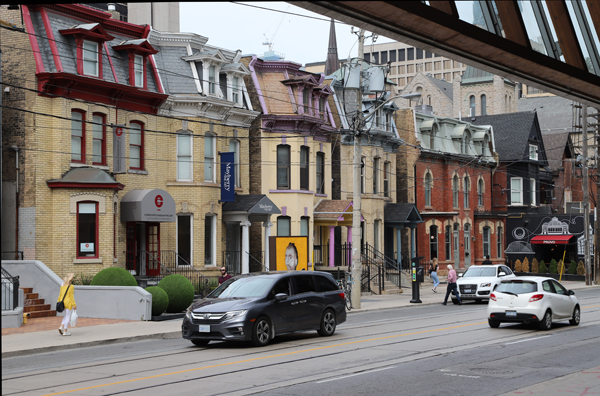
The second experiment with multiple exposure involved a street scene during my visit at the Art Gallery of Ontario. I did not carry a tripod, and was simply shooting a view of the other side of the street while standing on the steps leading to the gallery. Unfortunately, really interesting street scenes would require a tripod and a slow exposure, and this is not easy (though not impossible) to achieve in all the hustle and bustle of an afternoon traffic on Dundas Street in Toronto. Still, the super-modern, designed by Frank Gehry, structure of the AGO, is beautifully complemented by the row of quirk old houses on the other side, just across the street.
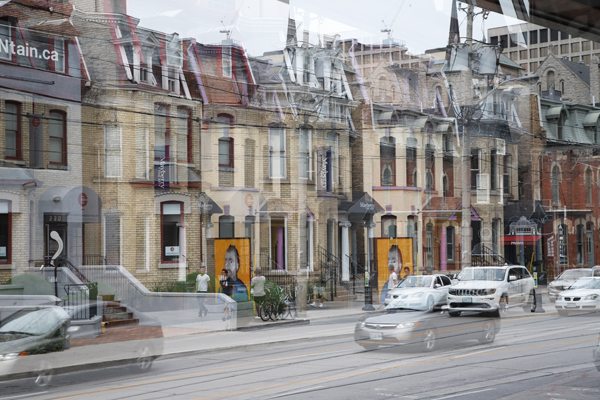
And it was those houses that I was photographing from the steps of the gallery. This time I needed more depth of field, so I set the aperture at 8.0, and then shot a single exposure, double exposure, and triple exposure of roughly the same scene. The ‘averaging’ mode resulted in the first shot executed at 1/125 sec, the second in 1/90 sec., and the third in 1/60 sec., still comfortably within my camera’s capabilities of hand-held shooting using my best Canon zoom lense EF 24-105 mm 1:4L IS with image stabilization, though I had to boost ISO to 200 to be on the safe side.
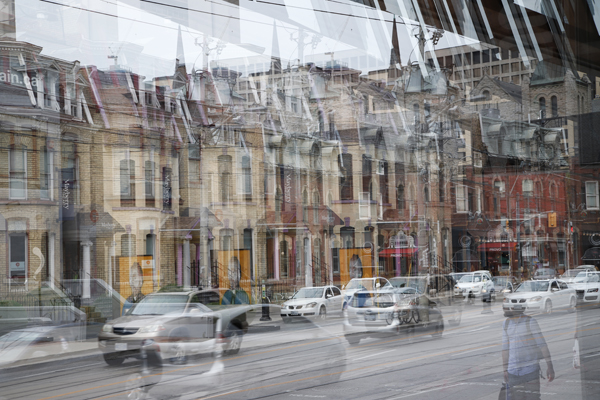
… and the amusing part of this experiment? Well, the first photo looks like taken by a sober person, the second – after, say, two glasses of wine, and the third after four glasses of wine.
A similar effect to that on the first picture (the three petals) can be achieved using a faux-multiple-exposure method by playing with layers and masks in Photoshop.
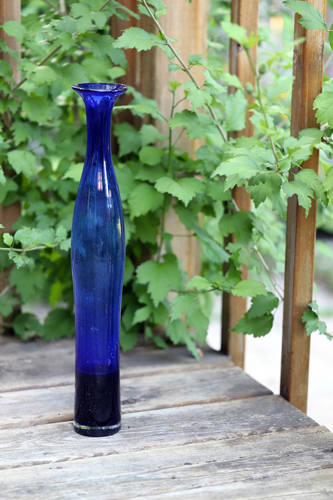

There was obviously only one blue glass object on the deck, but by cutting it (e.g. using the lasso tool), saving to its own layer, and then erasing redundant pixels around the object, and finally pasting (twice) to the original background and positioning within that background, we got what amounts to triple-exposure. It is false, because the frame has been exposed only once, and the single exposure is clearly visible by looking at the background, but the overall effect is still interesting.